Saturday, January 4, 2014

[Tanya] The beginning, the project, the team

Every trip to Kenya (for me) starts with a flurry of planning and coordination among a dozen or more people coming from all over the world, trying to converge on Mpala at more or less the same time. This time it’s a diverse team of scientists from engineering, computer science, and ecology (as well as Princeton students for the tropical ecology course). Our goal (more or less) is to fly drones over zebras and, using our HotSpotter software over video, to track and build models of movement and social interactions; to start a citizen science based project with nature preserves to use tourist photos to track animals and follow their population dynamics; to start a conversation among scientists who study various animals in that habitat to build a proof of concept ecological information system. So here is the team:
  • Dan Rubestein the ecologist (on the project, the course, in life, at Princeton). Main zebra guy. The main reason I ever got into zebras and to Mpala.
  • Chuck Stewart, the computer vision expert from RPI, who took SptripeSpotter to HotSpotter, a program that can identify any striped or spotted animal (yep, that’s Cathy) from photographs. And now will be using that for video from drones. And will be building the image based ecological information system (using the citizen science input from the nature preserves and everything else).
  • Sai Ravela and Co. from MIT, the drone (among other things) expert.
  • Lucas Joppa from Microsoft Research Cambridge, UK. One of the multitude of the things he does is the Technology for Nature project. Combining that, with Microsoft 4Afrika initiative, to do science, conservation and education, is an amazing opportunity.
  • Marco Maggioni, my PhD student, a former participant in the Kenya course 2012, and Clara Machogu, also a student from that course. They are coming back to help with the technical and human aspects of the citizen science project and everything else.

    Also coming are Meg Crofoot (an evolutionary anthropologist who studies movement and decision making in primates) and our postdoc Damien Farine to work on the baboon project. In 2012 Meg put super high resolution GPS collars on a troop of baboons at Mpala and followed them for a month. Now, using everything and dynamic analysis methods we are trying to make sense of those data and answer some deep biological questions about how social animals make decisions.

    Of course, with this many people, everything that can go wrong, will. Equipment shipping, permits, visas, schedules, flights. The biggest impediment to research, turns out, is snow. With the snow storm on the east coast, and Dan and the students, Chuck, Sai an Co, coming from NJ and Boston, we were worried that the whole thing will not happen. I, sitting on the veranda of the Mpala Ranch House (think Hemingway travel descriptions), was concerned that I would have to spend the rest of the trip as a vacation. Or even extend our stay here! But, miraculously, people are actually making it, after the delays.

  • [Eva] First impressions from a first timer

    This whole place is one big ant colony. Not that it’s particularly horrible (our house in the USA is pretty similar), but the ants are everywhere. They seem especially attracted to my soap… I’m sure all of you would rather hear about all of the animals we saw, but this seemed to be an easy place to start.

    We (my mother, father, 2 workers here, and I) went on a game ride yesterday. I got to sit on the roof, which was probably rather dangerous, but it was worth it. Besides, what fun is life if you don’t take risks? We did see quite a few animals (giraffes, zebras, and an elephant, to name a few), but what really stood out to me were the dik-diks. They are tiny antelopes that are adorable with the biggest eyes and the most amusing habits. They come in pairs, mostly, but at one point we saw three, and we joked that one of them was a “third wheel.” It’s really nice here (intentional stab at anyone with snow and/or temperatures below freezing) and we’ve been outside whenever we can. Over and out!

    Tuesday, January 24, 2012

    More quotes

    “Lets go to see the fish that eats those lamb chops!”
    Doug, one of the scientists here who studies river ecosystems, collected lamb chop remains the previous evening to use as bait for the fish. In the morning we all piled up to see if he caught something. He did.

    “Watch out for the monkeys on the road.”
    Tons of vervet monkeys running around. A particularly interesting case of sexual dimorphism

    “Why is the hippo bobbing up and down in the water?”
    ‘Cause he is making more hippos.

    Islam: “I haven’t used that software, I only looked at the code”

    “When you hit the tall grass on the soccer field – it’s nasty”
    Our course went to visit another course: undergrads from Cornell, living at the riverside campside (it’s very cushy, with platformed tents and electricity and everything). We played a game of soccer (we won) on a grassy field full of patches of tall grass and ground squirrel holes.

    “Why don’t the bushbabies come out? It’s time already!”
    While visiting Cornell course at the riverside camp, we waited for the bushbabies to come out in the dusk. They did eventually. Their eyes light up like huge orange saucers in the light of a flashlight. And they move so fast around the tree!

    “This line is to look at the midges under the microscope, the food line is the other one.”
    Still at Cornell. One of the faculty (an entomologist) from Cornell set up a microscope with midges (the same ones that infest the acacia trees, the same ones that one of the projects was studying) next to the food line.


    Dan: “You step on all dung you measure: if it’s green it’s two days old, if its soft it’s a week old, after that you don’t care. Spread your arms out, make a daisy chain (hold each other by hand) - that’s 4 meters. Then go through and count the dung.”
    Explaining how to measure animal activity through dung (for the boma project)

    Molly: “I think it would be hard to get the midge out of the cage without squishing it”

    Tires are always flat because of the acacia tree thorns. And so are soccer balls

    “Need to fly early in the morning, otherwise it’s too windy and hence bumpy.”
    But we did fly! It was out of this world AMAZING. We hooked up Macho Ya Mungu rig to the struts of a microlite airplane (smaller than Cessna) and flew over Mpala. 3D acacias! 3D zebras, giraffes and impala! 3D life from above!

    Moth in the hand soap.

    Dust everywhere. Everywhere. EVERYWHERE. And so are the ants.

    Wild dogs in the morning, giraffes in the evening.

    Impala on the road. Every evening. Jumping gracefully.

    Bruises on the butt from sitting on top of the car (on the roof) while it’s bouncing over the barely existing roads.

    Too many zebras (plains, not Grevy’s)

    The camera clicks are too loud and too numerous to enjoy the animals properly.

    The rubber boots are too thin to protect against acacia thorns.

    Group hug after mapping out the trees. Mapping the trees is hard.

    Jason: “I could wash dishes to pay for my stay on Mpala”
    Jason and I think that there are still many critical things that need to be done for the projects that require us to extend our stay here. We are writing a letter to our dean and department head.

    [Alessandro] Last days in Kenya.

    Our Kenya trip is sadly coming to a closing. Today the Princeton students leave, while the UIC troopers will leave tomorrow. The fact that this makes me feel sad is indicative of how great this experience has been.

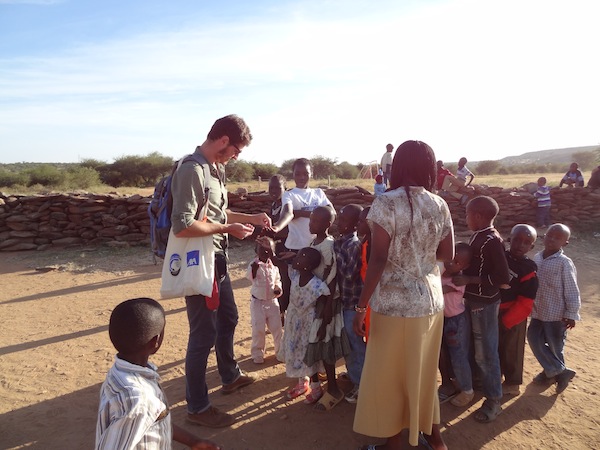
    On sunday we went up to the village for a soccer game and to distribute some candies and little gifts we had for the children. They literally went crazy and almost assaulted us at the first sight of bubble gums, but thanks to the help of the mothers we managed to have a fair distribution! The women collective was selling hand crafted items, so we also got to do some shopping, and we played with the kids while watching the soccer game. Interacting with them was extremely rewarding.

    Giving out candies to the kids.


    Marco tossing a little girl in the air!

    In other news, some of us went out on a game drive with Matt last night. We were so lucky to see a couple of animals that apparently are some of the rarest spots around here: one aardvark running through the grass and a couple of almighty honey badgers on our way back to the research centre!

    Saturday, January 21, 2012

    [Alessandro] Hyena puppies and wild dogs.

    Yesterday, a group of us spent the day at Ol Pejeta Wildlife Conservancy (the rest of us went there on Tuesday.) We didn't get to see any big cats, but we were lucky enough to see a pretty big group of adorable hyena puppies!

    Hyena Puppies at Ol Pejeta. In the background, a warthog and some gazelles.

    This morning, we all went out to the highest point in the Mpala ranch, in order to spot some wild dogs. We indeed saw several dogs, and when we got the the summit after a very pleasant hike, the panorama was breathtaking...

    Panorama from the highest point in the Mpala ranch.

    Wednesday, January 18, 2012

    Macho Ya Mungu


    Tanya and I spent the afternoon on Monday building a hyper stereo rig which consisted of two inverted tripods with HD video cameras on each end. We asked the Kenyan students for help in naming it and eventually settled on Macho Ya Mungu - the eyes of god (not too grandiose :)

    We took it out to Ol Pejeta the following day to test it out. Below are two cross-eye stereo snapshots of the videos. The subjects in the photos were over 50 feet away so the hyper stereo helped place them in depth. Partial zoom was used to bring the subjects close enough to see. Unfortunately of course that tends to flatten out the subjects so they look like cardboard cutouts in 3D.


    [Alessandro] Sunset game drive.

    A few of us (Emma, Jacob, and myself) went out on a drive with Rob yesterday before dinner. The light at that time of the day is simply beautiful, and when the sun starts setting nature displays its best. We ran into a group of zebras and gazelles watching out for two spotted hyenas nearby. It was interesting to see how calm the herbivores were once they were aware of the presence of the hyenas, who couldn't count on the surprise factor. Here's one of the hyenas.

    Spotted hyena at sunset.

    On the way back to the Research Centre, we drove by a giraffe. Little did the giraffe know that Rob was going to run out of the car and after the poor animal!

    Action shot: Rob chasing a giraffe.

    Sausage Fly

    This is the sausage fly:

    (I didn't have a decent picture, so I stole one from the internet)


    According to Wikipedia, it is the male of the army ant genus Dorylus, and its large abdomen is bloated with sperm. According to most people here, it is the queen, and its abdomen is bloated with eggs (and also sperm, hopefully). Either way, there seems to be agreement that these are the largest individuals in any ant species.

    Tanya claims to be deathly allergic to them; many others are deathly grossed out.

    According to local entomologist folklore, these queens seek out a new location to start a new colony. According to Wikipedia, these males seek out a colony with virgin queens; when they find one, their wings are cut off (by themselves or by worker ants), they impregnate the queen, and then their life is over. A remarkable case of convergent evolution with humans.

    When the time is right (which seems to be now, to Tanya's chagrin), all sausage flies leave their colony for the nuptial flight, to found or fertilize (depending on whom you are listening to) another colony.

    Of course, Islam knows how to deal with these apostates:


    Tuesday, January 17, 2012

    Ants everywhere

    A poem for the day. ☜ click this

    Every morning I wake up to find ants crawling all over my pillow and sheets. Which is actually a step up from sleeping in Chicago.

    Monday, January 16, 2012

    Smile for the camera !

    A happy camel coming back home to the Boma after some good grazing.