Saturday, January 31, 2015

Beauty of Mpala, Majesty of Nature

Sir David Attenborough describes Africa as “the only place on Earth to see the full majesty of nature”. Mammals, birds, insects, plants, and all the other organisms, there’s always “more to see than can ever be seen”. During the stay at Mpala, I felt so lucky to see Martial Eagle and Fish Eagle enjoying their meals, male dikdiks and giraffes practicing fighting skills, as well as wagtails’ and guineafowls’ devotion into the next generations: scenes that I’ve only heard about or seen from books and documentaries. 

I was always wondering what to do when I encountered interesting animals or their behaviors: can I move closer and closer, or stay as far as possible when I can observe them with my binoculars? Should I do differently when I have camera with me? Things become complicated if there’s a guide during game drive: they may assume that getting closer would make their clients more enjoyable, and which may usually be the case. The answer to the question for me seems to be using binoculars and the choice won’t change when I have camera: what I would enjoy is their normal behavior and interactions, but not to frighten them, interrupting their life or to see them walking away. 

It is true that I want to take good photos and share with others about what fantasies I’ve seen, but not from scaring wildlife, getting too close to them or even chasing them around as those would inevitably disturb and harm them: I wish others would also have the chance to see what I have seen out there in the wild, but not can only try to imagine that from old photos if we lost the wilderness of Africa.

Only when we show more respects and considerations to it, would the nature show its full majesty to us.

(More pieces that I was lucky enough to see when I was there can be found at https://www.flickr.com/photos/mu_tong/sets/72157650133570459/)

Monday, January 19, 2015

Python Spirit Guide

Computer science graduate students (left to right, Alessandro Oddone, Anthony Perritano) collaborating on a Python program to parse an image dataset. Alessandro, our 'Python Spirit Guide', a seasoned Python programmer answers questions as he platoons for different projects.

Thursday, January 15, 2015

Baboons in branches: a networked approach to how monkeys decide to turn down for the night

Having a home base is important for many animals. These places offer both shelter and predictability in the otherwise chaotic day-to-day happenings of an animal’s life. For many primate species, home is a stand of several trees centrally located within their home range. Although most primate species live exclusively in trees, baboons spend nearly their entire day foraging on the ground and only return to the trees in the evening to rest. As part of the Mpala Field Computational Ecology course, we are trying to understand how individual baboons make decisions about where to go and where to rest when they ascend their sleeping trees in the evening. This project includes computer scientists and biologists from several institutions:

Team:
Ph.D. Students
Ivan Brugere (Computer Scientist, University of Illinois- Chicago)
Vena Li (Computer Scientist, University of Illinois- Chicago)
Ari Strandburg-Peshkin (Biologist, Princeton University)

Post-Docs
Damien Farine (Biologist, UC-Davis, Oxford, and Smithsonian Institute)
David Pappano (Biologist, Princeton University)


We are focusing on a troop of olive baboons that rest near River Camp here at Mpala. Olive baboons (Papio anubis) are among the most common of these semi-terrestrial Old World monkeys living in east Africa. Their face and muzzle resemble the jackal-headed deity, Anubis, hence their scientific namesake. Olive baboons are female philopatric, meaning females remain in the same troop their entire life while males disperse at adulthood to join neighboring groups. A troop of olive baboons can range in size from 20-100, but tend to average around 50 individuals. Baboons are among the most successful groups of primates and can be found in a range of habitats throughout eastern and southern Africa from dry brush land to dense rainforest.

photo credit D. Farine

Every evening we head to River Camp within the Mpala Research Station and set up cameras to monitor a the baboon troop as their ascend their sleeping trees. To determine how individual baboons make decisions about where to go within their sleeping trees, we are modeling both the physical tree and the ascension paths the baboons take as networks. We are then using flow prediction over the network to understand how the state of the tree determines the baboon’s decision. Through this method we hope to uncover patterns that would not be directly observable to scientists on foot using more traditional focal-animal based sampling methods.

photo credit D. Pappano, network by I. Brugere


Sunday, January 4, 2015

Field Computational Ecology 2015 edition

Happy New 2015 Year everybody! Welcome to the 2015 edition of the Field Computational Ecology course. We are building on the success of the pilot version of the course from 2010 and the first full version in 2011-2012. The two courses produced 8 peer reviewed publications, 2 MS thesises, and many conference presentations by the students. This year, we have computer science students from University of Illinois at Chicago and ecology students from Princeton University and the Be'er Sheva University in Israel. We will converge at Mpala Research Centre in Kenya on January 7 and will spend the following two weeks working on a number of exciting interdisciplinary projects. Follow us on this blog!

The pilot version of the Field Computational Ecology course was in 2010 (read about it in earlier posts), funded by the Department of Ecology and Evolutionary Biology at Princeton University and the College of Engineering at the University of Illinois through the generosity of a private donation by Bill Unger. The first full version of the course in 2012 was supported by a grant from the US National Science Foundation. This year's course is supported separately by each department.

Friday, January 10, 2014

Mpala, the Saga Continues

Doctor’s Blog, Mpala date 1-7/8-14.

The hippo saga continues. Since we were unable to see the hippos out of water and cannot visit the hippo pool, Jackson took us down (or maybe up, don’t know) river from the pool. There, on the banks of the river, was a hippo mom and two calves. After watching them for a bit, they decided to return to the river. I can now report that at least three hippos in Mpala have legs. Visited the local school and village today. Very illuminating to see. It is also very humbling to see what the teachers achieve with so very few resources. Eva was feeling sick, so she stayed in her room.

Went to the Center in the afternoon, and visited the village where the Mpala workers live, which was also interesting. We bought some stuff (they have some really cool beadwork. Ike kids anywhere, they want you to take their photos, and then they run up to look at their photos, and then, of course they want another photo. Chuck was absolutely mobbed, much to his delight. Eva (who was feeling better) took Tanya’s camera and took photos of the kids and was immediately surrounded. They all had the greatest time taking silly photos and looking at them. Eva loved the village, and hopefully she’ll get to visit the school as well before we leave. I can’t post this because we do not have internet access on this side of the Center, and I’m too lazy to walk over to the library which may have internet access. Eventually we went back to the Ranch. Mike, the Ranch manager stayed for dinner, which was, as usual, excellent.


On the 8th, I spent the early morning trying, with some success, to photograph the sunbirds that visit the flowers outside our room. I got some photos of a female. We went to the Center late in the morning, I did this and that most of the day while people did science. Something with the baboons, I think, and something about animals with stripes and spots, and other stuff . I’m on vacation from such things, so Tanya can write about them. At 4 PM we went out on an evening game ride. It was raining so we were treated to a double rainbow. Eva pointed out that the second, paler, one was inverted. We saw elephants and gazelles, an eagle (a tawny eagle) and some species of hawk. The best part was, as we were returning, we were notified of cheetahs. We arrived after the Cornell undergraduate course. They had land rovers, while we had a modified mini-van, and we had to go off road to follow the cheetahs. However, we had Jackson as our driver. The land rovers got stuck or lost, and we came within about 50 meters of the cheetahs. We watched them for a bit until they got tired of us and went even deeper into the bush, and we went into a hole. We pushed the minivan out of the hole, helped the Cornell land rover out of the ditch, and went back for dinner before leaving on a night game ride. 

The night ride was great.  We off-trailed (i.e., went off the barely passable dirt roads and into the bush), we surprised herds of impalas, Grant’s gazelles, and zebras, and all sorts of other fun stuff. At one point, we went off-trail because Lucas claimed to have seen elephants. We could not see them, so we stopped to listen. We could not hear a thing, and Lucas was wondering whether he had been imagining things (though an elephant seems like a very big thing to imagine). Suddenly, Jackson’s sharp eyes spot something through trees, and after we drive only a little bit, and turn on our lights and spotlights, we see a herd of elephants, moving more silently than a single zebra could. We also saw a couple of honey badgers, who were not all that bad-ass, as well as a pair of jackals. We rolled in at about 10:30, and those of us who still could took showers and we all crashed. Va’yehi erev, va’yehi boker, yom shmini, or more correctly, va'yehi boker, va'yehi erev.

Monday, January 6, 2014

Mpala, the Sequel

Doctor’s Blog, Mpala date 1-6-14.

Woke up before dawn in the hope that we’ll be able to see the Hippos out of water, or at least do something more interesting than peek out of the surface, wiggle their ears and snort ever so often. They did. Sorta. They snorted more and louder, and we saw more than their ears and eyes. One of the babies actually came hallway out of the water. We do not, however, have any proof that the hippos of Mpala have legs. There was a vulture on the top of a nearby tree, where it likely spent the night. On the way back we saw some springbok, and a Cape buffalo crossed the road in front of us, which is cool.
Eva has taken to sitting on top of the Land Rovers, with her legs dangling into the opening in the roof (the one that allows us to stand up and see wildlife without getting out of the truck). We may have difficulty getting her to sit in the back seat when we get back home. Tanya and Chuck are doing computer stuff, Dan and Iain are with their course, and I’m on the veranda at the Ranch house blogging. All is right in the world.
In the afternoon, we will do baboon stuff with Meg.

On our way to the center for lunch, Jackson took us on a detour to see the hippos for the last time (they’re being tagged over the next week or so, and we cannot visit during that time). The hippos were being boring, however, there were a couple of elephants who came down to drink, a fishing eagle, a tree full of monkeys, and on the way from there to the Center, a beautiful kudu. Tanya and Chuck are trying to get as many photos of striped and spotted animals as possible. The most common phrases are “c’mon, turn”, and “Jackson, could you drive a little forward/back?” followed by the sound of multiple photos being shot.
We went to Meg’s baboon site, talked science, and then went to look for her baboons. We found them in trees. Actually it was a lot more exciting than that, since we could not see them in their regular trees from their feeding site. We did, however, find them a bit further along the river. And there was joy and rejoicing, and Meg scattered her corn, and went home secure in the knowledge that her research would proceed smoothly. Or something like that.
Then we had a nice dinner - Leslie (of Jenga-inventing fame) and Fritz came to dinner as well.

I also took photos of a gecko. 

[Tanya] Mpala magic

Waking up to the sunrise over Mt Kenya, watching an ibis in the front lawn while brushing teeth, impala at breakfast... This place is magic. Too bad the magic didn't rub off on the Kenyan embassy. Snow and cold and winds and blizzard could not prevent everybody from coming but the Kenyan embassy did keep Sai, the drone expert, away. So no drones. But the baboons and the all the image based ecological research, and (Lucas Joppa came today) the .net gadgeteer custom made camera traps... There is no lack of stuff to do.

More Mpala

Doctor’s Blog, Mpala date 1-4/5-14.

Another day, another game ride. It’s hard to believe that one can become blasé about seeing African wildlife in their native habitat, yet, we already do not stop to photograph Grant’s gazelles or impala’s, not to mention the omnipresent dik-diks.
Chuck and Lou-Ann arrived yesterday afternoon as did Iain, Dan and Nancy, Dan’s Tropical Ecology course students, as well as Nick and Katelin from the UAV crew. Sai, the head of the UAV crew wasn’t able to arrive due to a visa SNAFU.
While Dan and the students settled in, we took Chuck and Lou-Ann along with us (“us” being Tanya, Eva, and I) on a quick game ride, so that we could see elephants (we just saw a single elephant the day before, and were interested in seeing and photographing a herd). We left at about 2 PM, thinking that we would be back by 3. Four hours and 15 species of wildlife later, we finally got to see the elusive elephants of Mpala.
We got back to the Ranch, had dinner with enough guests to justify the giant dinner table in the Ranch’s dining room, and retired for the night.
This morning, after breakfast and some shop talk, Tanya, Eva, and I tagged along after Dan and Iain’s course’s first game ride. While Chuck and Lou-Ann drove with the course, Tanya, Eva, and I followed with Jackson, driver and wildlife spotter extraordinaire. We watched wildlife, listened in on Dan introducing his students to Mpala, and ingested a decent amount of Mpala (the fate of the last open car in a convoy). This time we saw elephants galore, as well as a number of herds of plains zebras, some ostriches, impalas, Grant’s gazelles, giraffes (a pair were starting to fight, but broke it off when we stopped to watch, and some guineafowl (and other animals).
Our list of species observed:
  1. Rock Mouse
  2. Grass Rat
  3. Ochre Bush Squirrel
  4. Unstriped Ground Squirrel
  5. Scrub hare
  6. Bats
  7. Black-backed Jackal
  8. Hippopotamus
  9. Giraffe
  10. Grant's Gazelle
  11. Thomson's Gazelle
  12. Impala
  13. Hartebeest
  14. Dikdik
  15. Greater Kudu
  16. Oryx
  17. Plains Zebra
  18. Grevy's Zebra
  19. Bush Hyrax
  20. Elephant
  21. Olive Baboon
  22. Vervet Monkey
  23. Red-headed rock agama
  24. Striped skink
  25. Ostrich
  26. Vulturine Guineafowl
  27. Yellow-necked Spurfowl
  28. Crested Francolin
  29. Egyptian Goose
  30. Black-headed heron
  31. Black-Shouldered kite
  32. Blacksmith Lapwing
  33. White-bellied Go-away Bird
  34. Lilac-breasted Roller
  35. Von der Decken's Hornbill
  36. Fischer's Sparrow-Lark
  37. Common bulbul
  38. Superb Starling
  39. Greater Blue-eared Starling
  40. Spotted Palm Thrush
  41. Scarlet-chested Sunbird
  42. Eastern Violet-backed Sunbird
  43. Marico sunbird
  44. White-browed Sparrow-Weaver
As you can see, I am in some sort of sensory overload daze, with which I cope by making lists.
Anyway, Meg and her (and Tanya’s) postdoc Damien arrived in the afternoon, as did Marco and Clara, so the crowd is here (except Sai). Back to the Ranch house for yet another wonderful dinner from the kitchen of our wondrous chef, Githai. Githai is also an amazing gardener, and most of the vegetables and herbs that we eat are from his garden.


What can I say? Field work is tough, but somebody need to make the sacrifice for the sake of our planet.

[Eva] Counting dik-dik

1 dik-dik, 2 dik-dik; red dik-dik, blue dik-dik. Well really, more like 1,000 dik-dik… Honestly, I should count dik-dik to get to sleep, rather than sheep. Sheep cause Q-Fever, dik-dik don’t. Do I really want to get Q-Fever in my sheep? No, so I should count dik-dik in my sleep instead of sheep. Hey, that rhymed! I can rhyme in time! ☺

There is a starling staring at me as I write. Its habits are sort of adorable. I wonder what the tags on its legs are for? (I’ll be back)…(I’m back!) My mother said that they are probably just for research, nothing interesting. :P

According to this National Geographic book on mammals, apparently there are 19 orders of mammal species. However, the book says that there are “thousands of species of mammals,” which is not very specific.

I feel as if my father will write a play-by-play, amusing description of what we did today, so I am free to write what I like really. I am going to write until the end of the page, and then I will stop.

I learnt some Swahili words from our driver, Jackson, so I can sort of talk to some of the people here (not really, but that’s what I like to think). I like the way Swahili words sound and feel in my mouth, however strange that sounds.

It’s really dusty and sunny here, so I always feel dry and dusty, but also sticky from the sunscreen, which kind of sucks. I am at the end of my page now, so Over and Out!

Saturday, January 4, 2014

[Mosheh] Doctor’s Blog, Mpala date 1-3-14.

So, I embark upon my first blogging experience. The word “blog”, and the verb derived from it “to blog” (I blog, I blogged, I will blog, I will have blogged, I need to blog, dammit!), remind me of Star Treck “Captain’s Log, star date 3631”, so I will start this:

Doctor’s Blog, Mpala date 1-3-14.

We began our journey to the Mpala Research Station on the first day of 2014, in the midst of winter snow. As expected, there were delays. However, it turned out that the delays had to do with difficulty in loading a cargo bin, not with the snow, which had tapered off, and was expected to resume the next day. The airline gave up on the cargo, de-iced the plane, and we were off. Not yet to Mpala, mind you, but to the transit port of Amsterdam. Despite our delay, we arrived in time for our Kenya-bound aircraft, which, luckily for us, but not for other passengers, was also delayed an hour or so. We even had to wait at the terminal for a while. Worried because of our previous delay, Tanya asked a young gentleman who worked for the airlines (KLM) if he could check whether our luggage had made it to the Nairobi-bound flight. This young gentleman came back, and, with a totally straight face, informed Tanya that our luggage never left Chicago. He managed to keep that straight face for about three minutes. He totally got us. After about an hour in the terminal, we boarded our flight, and we were off. 71/2 hours later, we landed in Nairobi, and emerged to a nice warm evening. After going through passport control, and waiting an hour for our luggage, we were taken to our hotel for the evening. The hotel was, as Tanya, using her newly-acquired set of Britishisms, “Very Posh”.
We arose the next morning, and after a nice breakfast, we were picked up by a van , and taken off to Mpala, five hours away. The ride was very interesting. I started in the outskirts of Nairobi, a city reminiscent of Middle Eastern cities, out onto a modern highway. The farther we got from Nairobi, the more things became unfamiliar. To begin with, rather than bridges over the highway, you had some major speed bumps that forced cars to slow down so that they would stop for people walking across this major highway.  The crossing were general next to small groups of multi-family buildings surrounding open-air markets. Then the highway tapered off, and we eventually were on a two-lane road. The settlements all looked like larger versions of those markets and buildings. When we got into Nanyuki, it seemed like a much larger version of this. We stopped to take out some cash, and we accosted by sellers. It was a distinctly interesting feeling of being in a place where I was instantly recognizable as a foreigner.
At Nanyuki we turn off the road to Mpala, and signs of human habitat started disappearing. We only saw some entrances to personal ranches. Then, suddenly, I had my first truly African experience, as an animal ran across the dirt road. With a certain sense of unreality I realized that this wasn’t some familiar canid or something familiar at all, but a baboon. Not something you’d see driving in the hinterlands of New Mexico, Illinois, or even Israel. However, things just got more, shall we say, African, as we turned a corner, and not 30 m away, we saw a full grown Giraffe. It sort of looked at us, decided that we were not interesting, and continued walking. We saw a few more animals, and then we were at the gates of Mpala.
The first thing you notice in Mpala is the road conditions. Evidently, to keep people from driving too fast, they limit repairs to the roads. When you consider the fact that Mpala is full of 20something rangers, and researchers with little sense of personal safety, you get the logic of this. Driving across these roads in a van was, ummmm, bumpy.
We got to the offices, where Tanya was greeted like a prodigal daughter, we were introduced to the various people there, ate lunch, and walked around a bit. Nobody had arrived from the different researchers, so we had some time to ourselves. We were taken to our accommodations, which is the ranch House in Mpala.It turns out that these were, as Tanya put it, “very posh”. Eva has her own room, and our room is like something out of the colonial times. A huge bed facing glass doors that open to a view of Mt Kenya, a canopied bed (mosquito netting), etc. We walked around the grounds and met an agamid lizard in full mating colors (blue body, red head), a hornbill, a tree hyrax who decided to join us on the veranda, and then the amazing chef/gardener Githai showed us around his wonderful kitchen garden (the source of most of our food) and his fruit trees, which he never got to eat from since the monkeys always get to the fruit first. We also saw one of these thieves. At 5 PM, we were taken by the amazing Jackson and Chanana out to an evening game ride in Mpala.
Eva has described the ride, so suffice to say that it was amazing. It is not a tourist area, so the animals behave a lot more like wild animals, and there were no other rides around. We also were not limited to regular tracks, so we got to see all sorts of stuff that tourists don not get to see. Because I love lists, here are what we saw (in no particular order:
  1. Herd of giraffes (nothing really can compare to a heard of giraffes on the run)
  2. Zebras (Grevys and plains)
  3. Elephant
  4. Hippos,
  5. Dik-diks
  6. Impalas
  7. Grant’s gazelles
  8. Wildebeast
  9. Dik-diks
  10. A troop of baboons
  11. Jackal
  12. Secretary bird
  13. Did I mention Dik-diks?
  14. Bustard
  15. Egyptian geese
  16. Ibis
  17. Herons
  18. Cranes
  19. Some more dik-diks
  20. Guineafowl
  21. Hornbills
  22. Vervet monkey
  23. And, of course, dik-diks…
Excuse me for the fact that I wasn’t more specific (as in writing what species these were), a cardinal sin for an ecologist, but, hey, I’m new here. Anyways, we probably saw more, so I’ll need to go through the photos to see what I have forgotten
As you can tell, it was a nice drive.
Around the ranch there is also no lack of wildlife, I’ve mentioned the hyrax and the monkeys. There are also baboons and Impalas, at least three species of sunbird, a squirrel, bulbuls (the only species I know from elsewhere), and more which I’ll mention later.

Enough for now, I’ll write more later.

[Tanya] The beginning, the project, the team

Every trip to Kenya (for me) starts with a flurry of planning and coordination among a dozen or more people coming from all over the world, trying to converge on Mpala at more or less the same time. This time it’s a diverse team of scientists from engineering, computer science, and ecology (as well as Princeton students for the tropical ecology course). Our goal (more or less) is to fly drones over zebras and, using our HotSpotter software over video, to track and build models of movement and social interactions; to start a citizen science based project with nature preserves to use tourist photos to track animals and follow their population dynamics; to start a conversation among scientists who study various animals in that habitat to build a proof of concept ecological information system. So here is the team:
  • Dan Rubestein the ecologist (on the project, the course, in life, at Princeton). Main zebra guy. The main reason I ever got into zebras and to Mpala.
  • Chuck Stewart, the computer vision expert from RPI, who took SptripeSpotter to HotSpotter, a program that can identify any striped or spotted animal (yep, that’s Cathy) from photographs. And now will be using that for video from drones. And will be building the image based ecological information system (using the citizen science input from the nature preserves and everything else).
  • Sai Ravela and Co. from MIT, the drone (among other things) expert.
  • Lucas Joppa from Microsoft Research Cambridge, UK. One of the multitude of the things he does is the Technology for Nature project. Combining that, with Microsoft 4Afrika initiative, to do science, conservation and education, is an amazing opportunity.
  • Marco Maggioni, my PhD student, a former participant in the Kenya course 2012, and Clara Machogu, also a student from that course. They are coming back to help with the technical and human aspects of the citizen science project and everything else.

    Also coming are Meg Crofoot (an evolutionary anthropologist who studies movement and decision making in primates) and our postdoc Damien Farine to work on the baboon project. In 2012 Meg put super high resolution GPS collars on a troop of baboons at Mpala and followed them for a month. Now, using everything and dynamic analysis methods we are trying to make sense of those data and answer some deep biological questions about how social animals make decisions.

    Of course, with this many people, everything that can go wrong, will. Equipment shipping, permits, visas, schedules, flights. The biggest impediment to research, turns out, is snow. With the snow storm on the east coast, and Dan and the students, Chuck, Sai an Co, coming from NJ and Boston, we were worried that the whole thing will not happen. I, sitting on the veranda of the Mpala Ranch House (think Hemingway travel descriptions), was concerned that I would have to spend the rest of the trip as a vacation. Or even extend our stay here! But, miraculously, people are actually making it, after the delays.

  • [Eva] First impressions from a first timer

    This whole place is one big ant colony. Not that it’s particularly horrible (our house in the USA is pretty similar), but the ants are everywhere. They seem especially attracted to my soap… I’m sure all of you would rather hear about all of the animals we saw, but this seemed to be an easy place to start.

    We (my mother, father, 2 workers here, and I) went on a game ride yesterday. I got to sit on the roof, which was probably rather dangerous, but it was worth it. Besides, what fun is life if you don’t take risks? We did see quite a few animals (giraffes, zebras, and an elephant, to name a few), but what really stood out to me were the dik-diks. They are tiny antelopes that are adorable with the biggest eyes and the most amusing habits. They come in pairs, mostly, but at one point we saw three, and we joked that one of them was a “third wheel.” It’s really nice here (intentional stab at anyone with snow and/or temperatures below freezing) and we’ve been outside whenever we can. Over and out!

    Tuesday, January 24, 2012

    More quotes

    “Lets go to see the fish that eats those lamb chops!”
    Doug, one of the scientists here who studies river ecosystems, collected lamb chop remains the previous evening to use as bait for the fish. In the morning we all piled up to see if he caught something. He did.

    “Watch out for the monkeys on the road.”
    Tons of vervet monkeys running around. A particularly interesting case of sexual dimorphism

    “Why is the hippo bobbing up and down in the water?”
    ‘Cause he is making more hippos.

    Islam: “I haven’t used that software, I only looked at the code”

    “When you hit the tall grass on the soccer field – it’s nasty”
    Our course went to visit another course: undergrads from Cornell, living at the riverside campside (it’s very cushy, with platformed tents and electricity and everything). We played a game of soccer (we won) on a grassy field full of patches of tall grass and ground squirrel holes.

    “Why don’t the bushbabies come out? It’s time already!”
    While visiting Cornell course at the riverside camp, we waited for the bushbabies to come out in the dusk. They did eventually. Their eyes light up like huge orange saucers in the light of a flashlight. And they move so fast around the tree!

    “This line is to look at the midges under the microscope, the food line is the other one.”
    Still at Cornell. One of the faculty (an entomologist) from Cornell set up a microscope with midges (the same ones that infest the acacia trees, the same ones that one of the projects was studying) next to the food line.


    Dan: “You step on all dung you measure: if it’s green it’s two days old, if its soft it’s a week old, after that you don’t care. Spread your arms out, make a daisy chain (hold each other by hand) - that’s 4 meters. Then go through and count the dung.”
    Explaining how to measure animal activity through dung (for the boma project)

    Molly: “I think it would be hard to get the midge out of the cage without squishing it”

    Tires are always flat because of the acacia tree thorns. And so are soccer balls

    “Need to fly early in the morning, otherwise it’s too windy and hence bumpy.”
    But we did fly! It was out of this world AMAZING. We hooked up Macho Ya Mungu rig to the struts of a microlite airplane (smaller than Cessna) and flew over Mpala. 3D acacias! 3D zebras, giraffes and impala! 3D life from above!

    Moth in the hand soap.

    Dust everywhere. Everywhere. EVERYWHERE. And so are the ants.

    Wild dogs in the morning, giraffes in the evening.

    Impala on the road. Every evening. Jumping gracefully.

    Bruises on the butt from sitting on top of the car (on the roof) while it’s bouncing over the barely existing roads.

    Too many zebras (plains, not Grevy’s)

    The camera clicks are too loud and too numerous to enjoy the animals properly.

    The rubber boots are too thin to protect against acacia thorns.

    Group hug after mapping out the trees. Mapping the trees is hard.

    Jason: “I could wash dishes to pay for my stay on Mpala”
    Jason and I think that there are still many critical things that need to be done for the projects that require us to extend our stay here. We are writing a letter to our dean and department head.

    [Alessandro] Last days in Kenya.

    Our Kenya trip is sadly coming to a closing. Today the Princeton students leave, while the UIC troopers will leave tomorrow. The fact that this makes me feel sad is indicative of how great this experience has been.

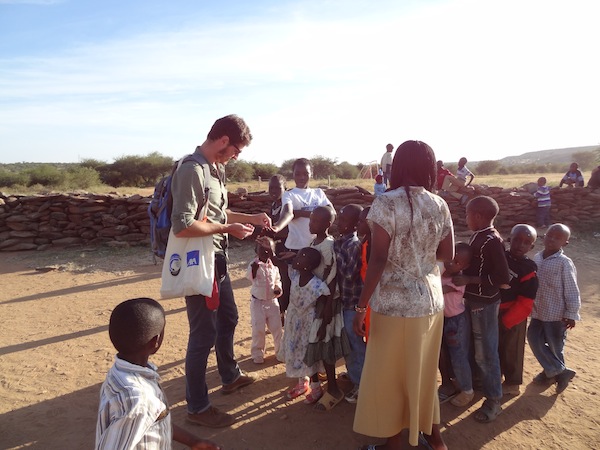
    On sunday we went up to the village for a soccer game and to distribute some candies and little gifts we had for the children. They literally went crazy and almost assaulted us at the first sight of bubble gums, but thanks to the help of the mothers we managed to have a fair distribution! The women collective was selling hand crafted items, so we also got to do some shopping, and we played with the kids while watching the soccer game. Interacting with them was extremely rewarding.

    Giving out candies to the kids.


    Marco tossing a little girl in the air!

    In other news, some of us went out on a game drive with Matt last night. We were so lucky to see a couple of animals that apparently are some of the rarest spots around here: one aardvark running through the grass and a couple of almighty honey badgers on our way back to the research centre!

    Saturday, January 21, 2012

    [Alessandro] Hyena puppies and wild dogs.

    Yesterday, a group of us spent the day at Ol Pejeta Wildlife Conservancy (the rest of us went there on Tuesday.) We didn't get to see any big cats, but we were lucky enough to see a pretty big group of adorable hyena puppies!

    Hyena Puppies at Ol Pejeta. In the background, a warthog and some gazelles.

    This morning, we all went out to the highest point in the Mpala ranch, in order to spot some wild dogs. We indeed saw several dogs, and when we got the the summit after a very pleasant hike, the panorama was breathtaking...

    Panorama from the highest point in the Mpala ranch.

    Wednesday, January 18, 2012

    Macho Ya Mungu


    Tanya and I spent the afternoon on Monday building a hyper stereo rig which consisted of two inverted tripods with HD video cameras on each end. We asked the Kenyan students for help in naming it and eventually settled on Macho Ya Mungu - the eyes of god (not too grandiose :)

    We took it out to Ol Pejeta the following day to test it out. Below are two cross-eye stereo snapshots of the videos. The subjects in the photos were over 50 feet away so the hyper stereo helped place them in depth. Partial zoom was used to bring the subjects close enough to see. Unfortunately of course that tends to flatten out the subjects so they look like cardboard cutouts in 3D.


    [Alessandro] Sunset game drive.

    A few of us (Emma, Jacob, and myself) went out on a drive with Rob yesterday before dinner. The light at that time of the day is simply beautiful, and when the sun starts setting nature displays its best. We ran into a group of zebras and gazelles watching out for two spotted hyenas nearby. It was interesting to see how calm the herbivores were once they were aware of the presence of the hyenas, who couldn't count on the surprise factor. Here's one of the hyenas.

    Spotted hyena at sunset.

    On the way back to the Research Centre, we drove by a giraffe. Little did the giraffe know that Rob was going to run out of the car and after the poor animal!

    Action shot: Rob chasing a giraffe.

    Sausage Fly

    This is the sausage fly:

    (I didn't have a decent picture, so I stole one from the internet)


    According to Wikipedia, it is the male of the army ant genus Dorylus, and its large abdomen is bloated with sperm. According to most people here, it is the queen, and its abdomen is bloated with eggs (and also sperm, hopefully). Either way, there seems to be agreement that these are the largest individuals in any ant species.

    Tanya claims to be deathly allergic to them; many others are deathly grossed out.

    According to local entomologist folklore, these queens seek out a new location to start a new colony. According to Wikipedia, these males seek out a colony with virgin queens; when they find one, their wings are cut off (by themselves or by worker ants), they impregnate the queen, and then their life is over. A remarkable case of convergent evolution with humans.

    When the time is right (which seems to be now, to Tanya's chagrin), all sausage flies leave their colony for the nuptial flight, to found or fertilize (depending on whom you are listening to) another colony.

    Of course, Islam knows how to deal with these apostates:


    Tuesday, January 17, 2012

    Ants everywhere

    A poem for the day. ☜ click this

    Every morning I wake up to find ants crawling all over my pillow and sheets. Which is actually a step up from sleeping in Chicago.

    Monday, January 16, 2012

    Smile for the camera !

    A happy camel coming back home to the Boma after some good grazing.